

50 Questions Every Patient Should Ask Before Switching
Generic name: Insulin icodec
Type: Once-weekly basal insulin
Manufacturer: Novo Nordisk
For: Appropriately selected adults with diabetes
Most important fact: It replaces basal insulin, not every insulin injection.
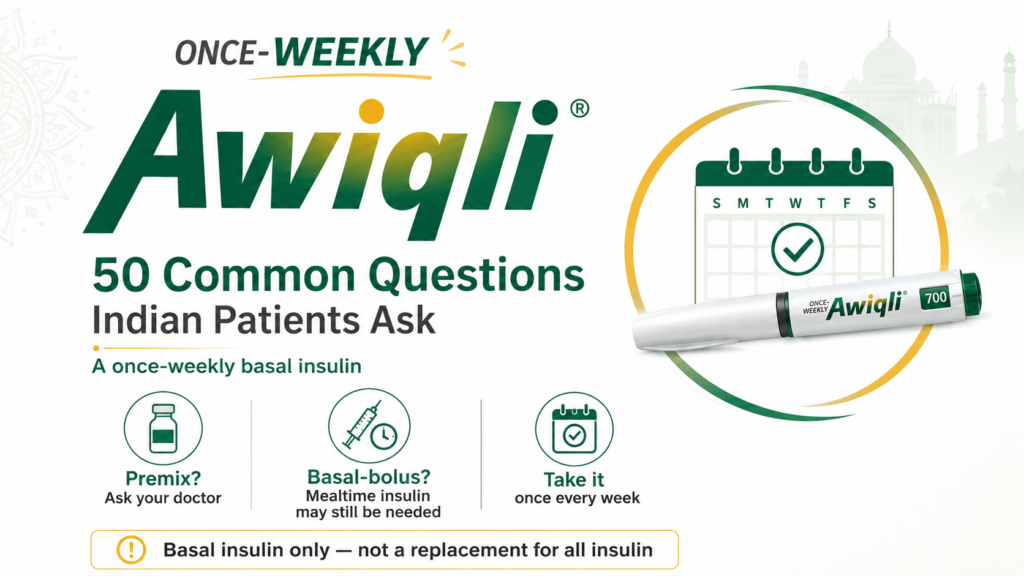
Introduction: One Weekly Injection – But Not for Everyone
Awiqli® has created tremendous excitement in India. For someone taking one basal insulin injection every day, changing to once-weekly basal insulin could reduce the number of basal injections from approximately 365 to 52 per year.
However, many patients are understandably asking:
“Doctor, I am taking insulin two, three or four times daily. Can I stop all those injections and take Awiqli only once a week?”
The answer is often no.
Awiqli is a basal insulin. Basal insulin provides background insulin coverage between meals and overnight. It does not automatically control the glucose rise after breakfast, lunch or dinner.
This distinction is especially important for people using:
- Twice-daily premixed insulin.
- Basal–bolus insulin.
- Rapid-acting insulin before meals.
- Multiple daily injections for type 1 diabetes.
Awiqli may replace the basal component, but it does not necessarily replace the meal-related component.
Part 1: The Most Important Questions
1. What is Awiqli?
Awiqli is the brand name of insulin icodec, an ultra-long-acting basal insulin analogue developed by Novo Nordisk. It is injected under the skin once every week.
It provides background insulin coverage throughout the week. It is not a tablet, a weight-loss injection or a rapid-acting mealtime insulin.
References:
- European Medicines Agency. Awiqli: Summary of Product Characteristics.
- Blair HA. Insulin icodec: first approval. BioDrugs. 2024;38:717–724. PMID: 39031321.
2. Is Awiqli a basal insulin or a mealtime insulin?
Awiqli is strictly a basal insulin.
Basal insulin mainly controls glucose released continuously by the liver, particularly overnight and between meals. Rapid-acting or bolus insulin controls the rise in glucose after food.
Awiqli cannot replace mealtime insulin when mealtime insulin is medically required.
References:
- European Medicines Agency. Awiqli: Summary of Product Characteristics, section 4.2.
- Mathieu C, et al. ONWARDS 4. Lancet. 2023;401:1929–1940. PMID: 37156252.
3. How does one injection continue working for seven days?
After injection, insulin icodec binds reversibly to albumin, a naturally occurring protein in the blood.
Albumin acts like a circulating storage reservoir. Most of the insulin initially remains bound and relatively inactive. Small amounts are gradually released throughout the week.
Insulin icodec also has reduced receptor-mediated clearance and an approximate half-life of one week.
References:
- Nishimura E, et al. Molecular and pharmacological characterisation of insulin icodec. BMJ Open Diabetes Res Care. 2021;9:e002301. PMID: 34413118.
- Pieber TR, et al. Pharmacokinetic and pharmacodynamic properties of once-weekly insulin icodec. Diabetes Obes Metab. 2023;25:3716–3723. PMID: 37694740.
4. Does “once-weekly insulin” mean that every patient needs only one injection a week?
No. This is the biggest misconception about Awiqli.
The term “once-weekly” applies only to the basal insulin component.
A person using only basal insulin may potentially change from seven basal injections per week to one. A person who also needs insulin with meals will usually continue those mealtime injections.
References:
- European Medicines Agency. Awiqli: Summary of Product Characteristics.
- Novo Nordisk. Insulin icodec explained – scientific backgrounder.
5. “Doctor, I take premixed insulin twice daily. Can I stop both injections and take Awiqli once weekly?”
Not as a direct replacement.
Premixed insulin usually contains two components in the same injection:
- A rapid- or short-acting component for food.
- An intermediate or longer-acting component for background insulin.
Awiqli provides only the background, or basal, component. It does not provide the meal coverage contained in premixed insulin.
Therefore, replacing twice-daily premixed insulin with Awiqli alone could leave the patient without sufficient mealtime insulin and cause high post-meal glucose.
Changing from premixed insulin may be possible, but the doctor may need to completely redesign the treatment using Awiqli plus tablets, a GLP-1 medicine, or separate mealtime insulin.
Do not stop premixed insulin and start Awiqli independently. This is not a one-to-one switch.
References:
- Maiorino MI, et al. Premixed insulin regimens in type 2 diabetes: pros. Endocrine. 2017;55:45–50. PMID: 27003435.
- European Medicines Agency. Awiqli: Summary of Product Characteristics.
6. “Doctor, I take basal–bolus insulin four times daily. Can Awiqli reduce it to one injection weekly?”
Usually, no.
A basal–bolus regimen normally consists of:
- One or two basal injections for background insulin.
- Rapid-acting insulin before meals.
Awiqli may replace the daily basal injection, but the patient will generally continue rapid-acting insulin before meals.
For example, someone taking one basal injection plus three mealtime injections daily may change from four injections per day to approximately three mealtime injections per day plus one weekly basal injection – not to one injection per week.
ONWARDS 4 specifically studied adults with type 2 diabetes using basal–bolus therapy. Awiqli replaced the basal insulin, while insulin aspart continued with meals.
References:
- Mathieu C, et al. Switching to once-weekly insulin icodec in basal–bolus-treated type 2 diabetes: ONWARDS 4. Lancet. 2023;401:1929–1940. PMID: 37156252.
- Candido R, et al. Basal–bolus therapy in diabetes mellitus. Diabetes Ther. 2018;9:927–949. PMID: 29654514.
7. “I take only one basal insulin injection daily. Am I a more straightforward candidate?”
Potentially, yes.
Adults taking only once-daily glargine, degludec, detemir or another basal insulin are the group in whom the practical concept is simplest:
Daily basal insulin may be replaced by weekly basal insulin.
However, the weekly dose must still be calculated by the treating doctor. Recent hypoglycaemia, fasting-glucose patterns, kidney function and concurrent medicines must be considered.
References:
- Philis-Tsimikas A, et al. ONWARDS 2. Lancet Diabetes Endocrinol. 2023;11:414–425. PMID: 37148899.
- Rosenstock J, et al. ONWARDS 10. Diabetes Obes Metab. 2026. PMID: 42168822.
8. “I take basal insulin twice daily. Can I switch?”
A switch may be possible in selected adults, but it requires additional care.
The doctor must calculate the total basal dose used over 24 hours, not just one of the two injections. The reason twice-daily basal insulin was required must also be reviewed.
ONWARDS 2 included adults previously using once- or twice-daily basal insulin, but switching followed a structured trial protocol.
Reference:
Philis-Tsimikas A, et al. ONWARDS 2. Lancet Diabetes Endocrinol. 2023;11:414–425. PMID: 37148899.
9. How many injections can Awiqli reduce?
For someone using one basal injection every day:
- Daily basal insulin: approximately 365 injections per year.
- Weekly Awiqli: approximately 52 injections per year.
This reduction applies only to basal injections. It does not include:
- Rapid-acting insulin injections.
- Premixed insulin injections.
- Finger-prick glucose tests.
- CGM sensor insertions.
Reference:
Novo Nordisk. Insulin icodec explained – scientific backgrounder.
10. Is Awiqli genuinely a game changer?
Yes! but it is a basal-insulin game changer, not a replacement for all diabetes treatment.
Its main advantages are fewer basal injections, reduced treatment burden and potentially better treatment satisfaction. Its limitations include reduced flexibility after a dose has been given and the possibility of prolonged hypoglycaemia after excessive dosing.
References:
- Bajaj HS, et al. ONWARDS 5. Ann Intern Med. 2023;176:1476–1485. DOI: 10.7326/M23-1288.
- Bellary S, Barnett AH. Insulin icodec: evolution or revolution? Lancet Diabetes Endocrinol. 2023;11:379–380. PMID: 37150185.
Part 2: Approval and Patient Selection
11. Is Awiqli approved and available in India?
India’s CDSCO Subject Expert Committee recommended permission to import and market insulin icodec 700 units/mL for treating diabetes mellitus in adults.
The recommendation specified that it should be prescribed by a registered endocrinologist or a physician with postgraduate qualification in medicine. Awiqli was subsequently launched in India in July 2026.
Availability may initially vary between cities and pharmacies.
References:
- CDSCO. SEC Endocrinology and Metabolism recommendations, June 19, 2024.
- Novo Nordisk India launch announcement reported July 2026.
12. Is Awiqli approved for the same patients in India, Europe and the United States?
No.
India and the European Union use the broader indication of treating diabetes mellitus in adults. European information includes adult type 1 diabetes when Awiqli is combined with bolus insulin.
The United States indication is restricted to adults with type 2 diabetes.
Patients should follow the prescribing information applicable to their own country.
References:
- CDSCO SEC recommendation, June 2024.
- European Medicines Agency. Awiqli Product Information.
- Novo Nordisk. Awiqli U.S. Prescribing Information, 2026.
13. Can children or teenagers use Awiqli?
Awiqli is currently intended for adults.
Its safety and effectiveness have not been established in people younger than 18 years. It should not be used in children or teenagers merely to reduce injection frequency.
References:
- European Medicines Agency. Awiqli Product Information.
- Novo Nordisk. Awiqli U.S. Prescribing Information, section 8.4.
14. Can an adult with type 1 diabetes use Awiqli in India?
The Indian and European adult indications permit its use in appropriately selected adults with type 1 diabetes.
However, it must be combined with rapid-acting or short-acting insulin for meals. It should be considered more cautiously than routine use in type 2 diabetes because hypoglycaemia was more frequent with icodec than degludec in ONWARDS 6.
References:
- Mathieu C, et al. ONWARDS 6. Lancet. 2023. PMID: 37863084.
- European Medicines Agency. Awiqli Product Information.
- Efficacy and safety in Indian participants from ONWARDS 1, 4 and 6. PMID: 41051694.
15. Why is there greater caution in type 1 diabetes?
In ONWARDS 6, Awiqli achieved HbA1c control comparable with once-daily degludec. However, the combined rate of clinically significant or severe hypoglycaemia was higher with weekly icodec.
Because the entire basal dose for one week has already been administered, rapid correction of excessive basal insulin exposure is more difficult.
References:
- Mathieu C, et al. ONWARDS 6. Lancet. 2023. PMID: 37863084.
- Systematic review of once-weekly basal insulin in type 1 diabetes. Diabetes Obes Metab. 2025. PMID: 41048193.
16. Will a person with type 1 diabetes still need insulin before meals?
Yes! absolutely.
Awiqli only supplies basal insulin. People with type 1 diabetes must continue appropriate rapid-acting insulin for meals and corrections.
Stopping mealtime insulin can cause marked hyperglycaemia and diabetic ketoacidosis.
References:
- European Medicines Agency. Awiqli Product Information, section 4.2.
- Mathieu C, et al. ONWARDS 6. Lancet. 2023. PMID: 37863084.
17. Can a newly diagnosed person with type 1 diabetes start directly with Awiqli?
This is not established as routine practice.
ONWARDS 6 studied adults with established type 1 diabetes who were already using basal–bolus treatment. It did not establish Awiqli as the preferred starting basal insulin in newly diagnosed, insulin-naïve type 1 diabetes.
Early insulin requirements may change rapidly, making a more easily adjustable daily basal insulin preferable.
References:
- Mathieu C, et al. ONWARDS 6. Lancet. 2023. PMID: 37863084.
- European Medicines Agency. Awiqli Product Information.
18. Can someone with type 2 diabetes who has never used insulin start Awiqli?
Yes, when basal insulin is clinically required.
ONWARDS 1 and ONWARDS 3 studied insulin-naïve adults with type 2 diabetes. Weekly icodec achieved HbA1c reductions that were at least comparable with and in these treat-to-target trials statistically greater than daily glargine or degludec.
The decision to start insulin must still be based on HbA1c, glucose levels, symptoms, other medicines and the patient’s clinical condition.
References:
- Rosenstock J, et al. ONWARDS 1. N Engl J Med. 2023;389:297–308. PMID: 37356066.
- Lingvay I, et al. ONWARDS 3. JAMA. 2023;330:228–237. PMID: 37354562.
19. Who is most likely to benefit?
Potential candidates include adults who:
- Need basal insulin but fear daily injections.
- Frequently forget daily basal insulin.
- Depend on a caregiver for injections.
- Experience significant injection fatigue.
- Have relatively stable basal-insulin requirements.
- Can understand and reliably follow a weekly schedule.
- Can monitor glucose during initiation and titration.
ONWARDS 5 reported improved treatment-satisfaction and treatment-compliance scores with weekly icodec plus dosing support.
Reference:
Bajaj HS, et al. ONWARDS 5. Ann Intern Med. 2023;176:1476–1485. DOI: 10.7326/M23-1288.
20. Who may not be an ideal candidate?
Extra caution is appropriate in people with:
- Recurrent severe hypoglycaemia.
- Markedly impaired awareness of hypoglycaemia.
- Highly unpredictable basal-insulin requirements.
- Frequent acute illnesses or hospital admissions.
- Repeated prolonged fasting.
- Rapidly changing kidney or liver function.
- Difficulty remembering whether the weekly dose was taken.
- A high risk of accidentally injecting it daily.
- Inability to monitor glucose adequately.
These are not necessarily absolute contraindications. They are reasons for careful specialist assessment.
References:
- Novo Nordisk. Awiqli U.S. Prescribing Information, warnings and precautions.
- European Medicines Agency. Awiqli Product Information.
Part 3: Other Diabetes Medicines
21. Can Awiqli be used with metformin and other diabetes tablets?
Yes, in type 2 diabetes, Awiqli may be used with appropriate non-insulin glucose-lowering medicines.
Treatment should be individualised. Starting insulin does not automatically mean that metformin or every other diabetes medicine must be stopped.
Reference:
European Medicines Agency. Awiqli Product Information, section 4.2.
22. What about sulfonylureas such as glimepiride or gliclazide?
Sulfonylureas can also cause hypoglycaemia.
When Awiqli is started, the doctor may reduce or stop the sulfonylurea depending on glucose levels, HbA1c, kidney function and hypoglycaemia risk.
Patients should not continue every previous medicine automatically without a medication review.
Reference:
European Medicines Agency. Awiqli Product Information, sections 4.2 and 4.5.
23. Can Awiqli be combined with semaglutide or another GLP-1 medicine?
Yes, in appropriately selected adults with type 2 diabetes.
ONWARDS 8 evaluated adding weekly semaglutide to adults treated with weekly icodec. Glucose control and body weight improved, but the insulin dose often required reassessment.
This is a combination of two different medicines: Awiqli supplies basal insulin, while semaglutide acts through the GLP-1 pathway.
References:
- ONWARDS 8: insulin icodec intensified with weekly semaglutide. PMID: 42387310.
- European Medicines Agency. Awiqli Product Information.
24. Is Awiqli similar to Ozempic, Wegovy or Mounjaro?
No.
Awiqli is insulin. Semaglutide is a GLP-1 receptor agonist, while tirzepatide acts through GIP and GLP-1 receptors.
Awiqli is not primarily a weight-loss medicine. In some patients, insulin treatment can cause modest weight gain.
References:
- Philis-Tsimikas A, et al. ONWARDS 2. Lancet Diabetes Endocrinol. 2023. PMID: 37148899.
- European Medicines Agency. Awiqli Product Information.
25. Can Awiqli be used during pregnancy or breastfeeding?
Human pregnancy and breastfeeding data remain limited.
Women who are pregnant, planning pregnancy or breastfeeding should discuss whether a better-established insulin regimen is preferable. Insulin must never be stopped during pregnancy without arranging appropriate replacement treatment.
Reference:
Novo Nordisk. Awiqli U.S. Prescribing Information, sections 8.1 and 8.2.
26. Can older adults or people with kidney or liver disease use it?
Potentially, yes, but with individualised dosing and closer monitoring.
No automatic dose adjustment is recommended solely because of kidney or liver impairment. Nevertheless, insulin requirements and hypoglycaemia risk can change significantly in these conditions.
Older or frail adults may also have difficulty recognising or communicating symptoms of low glucose.
Reference:
Novo Nordisk. Awiqli U.S. Prescribing Information, sections 8.5–8.7.
Part 4: Starting and Switching
27. What is the usual starting dose in an insulin-naïve adult with type 2 diabetes?
Official European and U.S. information recommends 70 units once weekly for insulin-naïve adults with type 2 diabetes.
This is regulatory information not permission to self-start. A clinician must first confirm that insulin is required and provide a monitoring and titration plan.
References:
- European Medicines Agency. Awiqli Product Information.
- Novo Nordisk. Awiqli U.S. Prescribing Information, section 2.3.
- Rosenstock J, et al. ONWARDS 1. PMID: 37356066.
28. How is the weekly dose calculated when switching from daily basal insulin?
The weekly maintenance dose is related to the total amount of basal insulin previously used over seven days.
However, safe conversion involves more than simply multiplying a dose by seven. The doctor must consider:
- Recent fasting-glucose readings.
- Previous hypoglycaemia.
- Type of diabetes.
- Kidney and liver function.
- Concurrent sulfonylurea or mealtime insulin.
- Whether a special first dose is required.
- The 10-unit dose increments of the Awiqli pen.
Patients should never calculate their own conversion using an online table.
References:
- European Medicines Agency. Awiqli Product Information.
- Philis-Tsimikas A, et al. ONWARDS 2. PMID: 37148899.
29. Is a larger “loading dose” always required for the first injection?
Not necessarily.
Earlier switching studies and approved prescribing information used a one-time additional first dose in certain patients to maintain insulin coverage while icodec accumulated.
However, ONWARDS 10, published in 2026, found that adults with basal-insulin-treated type 2 diabetes could switch without an additional first dose while maintaining glycaemic control.
This newer evidence does not authorise patients to select their own switching method. Indian clinicians should follow the current Indian prescribing information and individualise the transition.
References:
- Bajaj HS, et al. Phase 2 switching trial. Diabetes Care. 2021;44:1586–1594.
- Rosenstock J, et al. ONWARDS 10. Diabetes Obes Metab. 2026. PMID: 42168822.
30. How long does it take to reach a stable effect?
Insulin icodec generally reaches steady state after approximately three to four weekly doses.
Therefore, its complete long-term pattern should not be judged after only the first injection. The dose should not be changed repeatedly based on isolated glucose readings.
Reference:
Pieber TR, et al. Diabetes Obes Metab. 2023;25:3716–3723. PMID: 37694740.
31. Does Awiqli have a peak day?
It is designed to provide a broad, week-long basal action rather than a sharp peak.
Pharmacological modelling suggests slightly more glucose-lowering activity during the earlier part of the week, but the effect continues throughout all seven days.
Patients should observe their weekly glucose pattern, particularly after starting or changing the dose.
Reference:
Pieber TR, et al. Diabetes Obes Metab. 2023;25:3716–3723. PMID: 37694740.
32. What does U-700 mean?
U-700 means that each millilitre contains 700 units of insulin icodec.
It is more concentrated than standard U-100 insulin. The high concentration allows an entire weekly dose to be delivered in a relatively small volume.
Patients must dial the prescribed number of units on the pen. They should not calculate the dose in millilitres.
References:
- European Medicines Agency. Awiqli Product Information.
- Novo Nordisk. Awiqli U.S. Prescribing Information.
33. Does U-700 mean it is seven times stronger?
Not in the way patients may assume.
One displayed unit remains one unit in the approved unit-expression system. U-700 describes the concentration of the liquid.
The prescribed units should never be divided by seven or converted using a U-100 insulin syringe.
Reference:
European Medicines Agency. Awiqli Product Information, section 4.2.
34. What pen sizes and dose increments are available?
Awiqli is supplied at a concentration of 700 units/mL in prefilled FlexTouch pens. Authorised presentations include pens containing:
- 700 total units.
- 1,050 total units.
- 2,100 total units.
The pen delivers doses in 10-unit increments, with up to 700 units per injection.
Actual availability may differ between Indian pharmacies.
References:
- CDSCO SEC recommendation.
- European Medicines Agency. Awiqli Product Information.
35. Can the weekly dose be divided between two different days?
Patients should not independently split the dose over two days.
Awiqli was designed and studied as one weekly dosing occasion. Splitting the dose may alter the intended pharmacological pattern and create dose overlap.
If a very large weekly dose requires more than one injection because of the pen’s delivery limit, both injections are generally given as part of the same weekly dosing occasion under medical instructions.
Reference:
European Medicines Agency. Awiqli Product Information.
Part 5: Taking Awiqli Correctly
36. Must it be taken on the same weekday?
Yes. It should usually be injected on the same day every week.
A fixed routine such as every Sunday morning helps prevent missed doses and accidental repeat doses. A phone alarm, calendar entry or caregiver record can be useful.
References:
- European Medicines Agency. Awiqli Product Information.
- Novo Nordisk. Awiqli U.S. Prescribing Information, section 2.1.
37. Must it be injected at exactly the same time?
The weekday is more important than the exact minute.
Using approximately the same time helps create a dependable routine. Awiqli is not usually linked to a particular meal.
A major schedule change should be discussed with the treating clinician.
Reference:
Novo Nordisk. Awiqli U.S. Prescribing Information and Patient Information.
38. What should I do if I miss the weekly dose?
Do not take two weekly doses close together without medical advice.
Missed-dose instructions can differ between national product labels. The U.S. label permits administration within four days of the missed dose and recommends skipping it if more than four days have passed.
Indian patients should follow the Indian leaflet supplied with the pen and contact the prescribing doctor. Glucose monitoring should be increased after a missed dose.
Reference:
Novo Nordisk. Awiqli U.S. Prescribing Information, section 2.5.
39. Can I change my weekly injection day?
It may be possible, but there must be adequate spacing between doses.
Changing the weekday incorrectly can cause two weekly doses to overlap or create an interval with insufficient basal insulin.
The new schedule should be confirmed by the treating doctor, especially in type 1 diabetes.
Reference:
European Medicines Agency. Awiqli Product Information.
40. Where should Awiqli be injected?
Approved injection areas are:
- Abdomen.
- Thigh.
- Upper arm.
Injection sites should be rotated. Avoid repeatedly injecting into lumps, thickened skin, scars, bruises or damaged skin.
It must not be injected into a vein or muscle.
Reference:
Novo Nordisk. Awiqli U.S. Prescribing Information, administration instructions.
41. Can it be mixed with another insulin or withdrawn with a syringe?
No.
Awiqli must not be mixed or diluted with another insulin. It must never be withdrawn from the FlexTouch pen into an insulin syringe.
Because Awiqli is U-700, using a U-100 syringe can cause a major overdose and severe, prolonged hypoglycaemia.
References:
- European Medicines Agency. Awiqli Product Information.
- Novo Nordisk. Awiqli U.S. Prescribing Information, medication-error warnings.
42. Can Awiqli be used in an insulin pump?
No.
It is intended for once-weekly subcutaneous injection using its prefilled pen. It should not be given through an insulin pump, intravenously or intramuscularly.
Reference:
Novo Nordisk. Awiqli U.S. Prescribing Information, section 2.2.
43. How should it be stored during Indian summers and travel?
Unused pens should generally be stored in a refrigerator at 2°C to 8°C, away from the freezer compartment. Never use insulin that has been frozen.
During Indian travel:
- Do not leave the pen inside a parked vehicle.
- Keep it away from direct sunlight.
- Do not place it directly against an ice pack.
- Carry it in hand luggage during air travel.
- Keep the prescription or pharmacy label with it.
The U.S. label permits room-temperature storage below 30°C for up to 12 weeks, but Indian patients should follow the storage period printed on the Indian carton and leaflet.
Reference:
Novo Nordisk. Awiqli U.S. Prescribing Information, storage and handling section.
Part 6: Monitoring and Safety
44. Can I stop finger-prick testing after starting weekly insulin?
No.
Fewer insulin injections do not mean that glucose monitoring is no longer required. Monitoring is particularly important:
- During the first few weeks.
- After changing from daily insulin.
- After a dose adjustment.
- After a missed or repeated dose.
- During illness or fasting.
- When mealtime insulin or sulfonylureas are also used.
CGM can be particularly valuable in type 1 diabetes, basal–bolus treatment and people with unrecognised hypoglycaemia.
References:
- Novo Nordisk. Awiqli U.S. Prescribing Information.
- CGM evaluation of ONWARDS 6. PMID: 40742780.
45. How is the weekly dose adjusted?
Dose adjustment is generally based on fasting or pre-breakfast glucose patterns, often using readings from several mornings rather than one isolated result.
Clinical studies adjusted the dose weekly. Patients should not make daily corrections to the weekly Awiqli dose.
Rapid-acting insulin may still be adjusted separately according to the prescribed mealtime plan.
Reference:
Lingvay I, et al. Comparison of once-weekly icodec titration strategies. Diabetes Care. 2021;44:1595–1603. PMID: 33875484.
46. What is the main side effect?
The most important side effect is hypoglycaemia.
Other possible insulin-related effects include:
- Weight gain.
- Injection-site reactions.
- Skin thickening or indentation.
- Localised cutaneous amyloidosis.
- Rash or allergic reactions.
- Peripheral swelling.
- Low potassium in susceptible patients.
References:
- Novo Nordisk. Awiqli U.S. Prescribing Information, sections 5 and 6.
- Pooled safety analysis of ONWARDS 1–6. PMID: 42119975.
47. Can hypoglycaemia last longer with Awiqli?
Yes.
Because insulin icodec remains active for a prolonged period, hypoglycaemia may recur after glucose initially improves. Continued monitoring and repeated carbohydrate may be required.
Confusion, seizure, unconsciousness, inability to swallow or repeated low readings require glucagon when available and urgent medical treatment.
Reference:
Novo Nordisk. Awiqli U.S. Prescribing Information, hypoglycaemia and overdose sections.
48. What should be done after an accidental extra weekly dose?
Treat it as a medical emergency, even when the person initially feels normal.
An excessive dose may cause severe, prolonged or recurrent hypoglycaemia and low potassium. The patient may require repeated oral carbohydrate, glucagon, intravenous glucose and prolonged medical observation.
Never wait for symptoms after:
- Taking Awiqli twice in the same week.
- Mistaking it for daily insulin.
- Injecting an incorrect large dose.
- Withdrawing it into a U-100 syringe.
Reference:
Novo Nordisk. Awiqli U.S. Prescribing Information, overdose and medication-error warnings.
49. Can someone fast for Ramadan, exercise heavily, undergo surgery or manage an acute illness while using Awiqli?
These situations require advance planning because the weekly dose cannot be removed once injected.
A controlled 2026 study in adults with type 2 diabetes found no clinically significant or severe hypoglycaemia during supervised exercise or fasting interventions. However, during an 18-hour fast, half of the participants required protocol-directed intravenous glucose.
Therefore, this small controlled study should not be interpreted as proof that prolonged or religious fasting is automatically safe.
The treating doctor may need to adjust other medicines, meal insulin, monitoring or the timing of Awiqli around:
- Ramadan or prolonged fasting.
- Vomiting or diarrhoea.
- Poor oral intake.
- Surgery.
- Hospital admission.
- Sudden heavy exercise.
- Steroid treatment.
References:
- Pieber TR, et al. Exercise or fasting in individuals receiving once-weekly insulin icodec. Diabetes Obes Metab. 2026. PMID: 42387301.
- Novo Nordisk. Awiqli U.S. Prescribing Information.
50. Is Awiqli as effective as daily basal insulin – and should I ask my doctor about switching?
In adults with type 2 diabetes, the ONWARDS phase 3 programme generally found weekly icodec to be non-inferior to daily basal insulin for HbA1c reduction. Some trials found modestly better HbA1c or time-in-range results with icodec.
In ONWARDS 1:
- HbA1c at 52 weeks was approximately 6.93% with icodec and 7.12% with glargine U100.
- Time in range was approximately 71.9% versus 66.9%.
A 2026 meta-analysis of once-weekly basal insulins in type 2 diabetes found broadly comparable glucose control and no statistically significant difference in combined level 2 or 3 hypoglycaemia overall.
However, the decision to switch should not be based only on the attraction of fewer injections.
Ask your doctor these five questions
- Am I using basal insulin alone, premixed insulin or basal–bolus therapy?
- Which part of my present insulin regimen would Awiqli replace?
- Will I still require mealtime insulin?
- How will my glucose be monitored during the first month?
- What should I do after a missed, repeated or incorrect dose?
References:
- Rosenstock J, et al. ONWARDS 1. N Engl J Med. 2023;389:297–308. PMID: 37356066.
- Participant-level meta-analysis of ONWARDS 1–5. PMID: 38951942.
- Raptis D, et al. Once-weekly versus daily basal insulin in type 2 diabetes: systematic review and meta-analysis. Curr Diab Rep. 2026. PMID: 42277362.
The One Message Every Patient Should Remember
Awiqli replaces basal insulin – not necessarily all insulin.
If you currently take only basal insulin
Awiqli may potentially replace your daily basal injection with one weekly basal injection.
If you use basal–bolus insulin
Awiqli may replace the basal component, but rapid-acting insulin before meals will generally continue.
If you use premixed insulin twice daily
Do not directly replace both premixed injections with Awiqli. Premixed insulin contains meal-related as well as background insulin. Your complete treatment regimen must be reassessed and redesigned by your doctor.
If you have type 1 diabetes
Awiqli cannot be used alone. Mealtime insulin remains essential, and hypoglycaemia requires particular attention.
Final Take – Home Message
Awiqli is an important scientific advance. It may reduce injection burden, improve treatment convenience and help some adults overcome reluctance to start or continue basal insulin.
But:
Once-weekly does not mean one insulin for everyone.
Once-weekly does not mean no monitoring.
Once-weekly does not mean all mealtime injections can be stopped.
The greatest danger is not the medicine itself it is misunderstanding which part of the insulin regimen it replaces.
Never stop premixed insulin, basal–bolus insulin or mealtime insulin and begin Awiqli without a complete treatment plan from a qualified endocrinologist or physician.
Medical Disclaimer
This article is intended for general public education. It does not provide an individual prescription, dose-conversion formula or recommendation to start or switch insulin.
Insulin should be initiated and adjusted only by a qualified treating clinician. Seek urgent medical assistance after an accidental extra dose, use of Awiqli more frequently than weekly, recurrent hypoglycaemia, seizure, unconsciousness or inability to take oral carbohydrate.